The
National Botanical Garden of Namibia
The
National Botanic
Garden of Namibia is situated in Windhoek and is the only botanic garden
in the country. It is one of the four sections of the National Botanical
Research Institute (NBRI) under the Ministry of Agriculture, Water, and
Rural Development. The land where the garden is being developed was donated
to the Government of Namibia by the city council of Windhoek in October
1969. It was proclaimed as a game reserve under Section 28 of the Nature
Conservation Ordinance 31 of 1967, and earmarked to be developed as a Nature
Garden.
In the early 1970s, the then Department of Nature Conservation
constructed self-guided trails, an irrigation system, and a water feature
comprising a dam and cemented water canals. Constraints on financial resources
resulted in the termination of this development and vandalism subsequently
destroyed most of what had been achieved. In July 1992, negotiations on
the development of the garden were initiated between the Ministry of Environment
and Tourism and the Ministry of Agriculture, Water, and Rural Development.
In February 1993, the NBRI obtained the right to develop the land into a
botanic garden, on condition that the area remained a proclaimed nature
reserve and that a steering committee between the two Ministries was established.
The objectives of the National Botanic Garden of Namibia are to:
Serve as a floral conservation area.
Serve as an outdoor environmental education facility,
educating the public on our natural resources, our Namibian flora, and nature
awareness in general.
Provide a study area for the flora of Namibia and its
ecology, especially the vegetation in and around Windhoek.
Serve as a training centre, where field workers, extension
personnel, students, and researchers may gain practical experience in survey
techniques and plant identifications.
Provide a supportive service for research projects, through
conservation, regeneration, and cultivation.
Serve as a recreational area and a tourist attraction.
Ex Situ Conservation
In the1970s, Euphorbia virosa from the Semi-Desert and Savanna Transition,
Pachypodium lealii from the
Mopane Savanna (also found in Mountain Savanna and Karstveld), Aloe dichotoma from the Dwarf Shrub Savanna in the south of the
country, Aloe dewinteri, Aloe striata subsp. karasbergensis, and several other species were planted in the garden.
Some of these plants are of high conservation value as they are protected
endemic and threatened species. Ex situ plant propagation of these species also serve as a display
for educating the public in plant conservation.
In Situ Conservation
About 99% of the vegetation in the garden is natural. Emphasis is placed
on the plants in their natural environment rather than artificial landscaping
of the garden. There are different vegetation types in the country that
need representation in the garden. Plants largely from the Highland Savanna
where the garden is situated will be introduced, since the garden environment
is not suitable to plants from other regions. To date 106 plant species
have been recorded in the garden, which boasts one of the densest stands
of Aloe littoralis. These provide
a wonderful display of flowers during April and May.
Nursery Collections
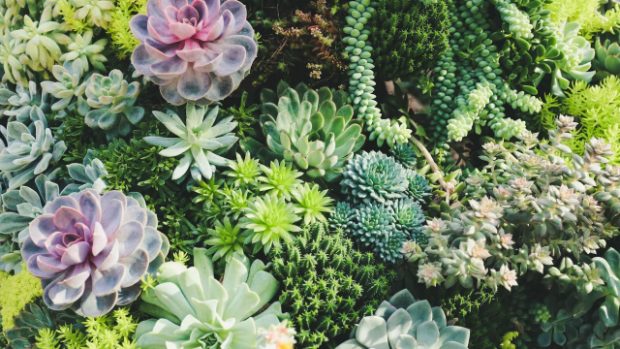
At present the nursery accommodates plants, mostly succulents, relocated
from the Skorpion Zinc Mine area (Burke 1999). This was a collaborative
effort by the NBRI and Reunion Mining. Propagation trials have been conducted
to find suitable methods for replanting the rescued species at the mining
site during rehabilitation efforts. Some of these include Euphorbia
melanohydrata
Most of the specimens in the nursery are mesembs and
crassulas. Also found in the nursery are specimens of Aloe zebrina, Aloe dewinteri, Euphorbia kaokoensis, and Cyphostemma uter.
The Display House
The Display House consists of the Tropical Section and the Desert Section;
the Tropical Section is still under development. The Desert Section is divided
into winter rainfall and summer rainfall areas and is landscaped to represent
the rock outcrops, sandy plains, and gravel plains of the Namib Desert.
Succulent plants, such as Ebracteola derenbergia (a southern Namib endemic), Sansevieria spp., Euphorbia spp., Bulbine spp., and Sarcocaulon patersonii (bushman’s candle) are displayed in the Desert
Section. The purpose of the Display House is to introduce the public, students,
and learners to the plants found in the Namib Desert, as well as their natural
habitats. With the Display House, we hope to promote the sustainable use
and conservation of our natural plant resources.
Future Plans
Many improvements and changes are planned for the garden. Raising the beds
to improve plant viewing will enhance the layout of the Desert Section in
the Display House. The Tropical Section has to be planned to accommodate
plants from the northeast (subtropical area) of the country. The living
plant collections (LPC) in the nursery will be sorted out and plants grouped
according to their families; all data will be entered in the LPC record
book. Space will be created in the nursery for a Threatened Plants Programme
planned by the Southern African Botanical Gardens Network and implemented
by the gardens in the region. Despite the vulnerability of succulents to
the rock hyrax found in the garden, a succulent area is planned where, amongst
others, Cyphostemma uter, Tylecodon racemosus, Hoodia parviflora, and Aloe species
will be planted. Visitors will be able to observe the succulent plant diversity
of Namibia and will be encouraged to appreciate the role of both ex situ and in
situ
conservation.
Read
more about collaboration
with the Karoo National Botanical Garden in South Africa.
—by Tobias Angula
SABONET
News 6.3: 204
BURKE,
A. 1999. Sting in the tail. SABONET
News 4(1): 37–39.